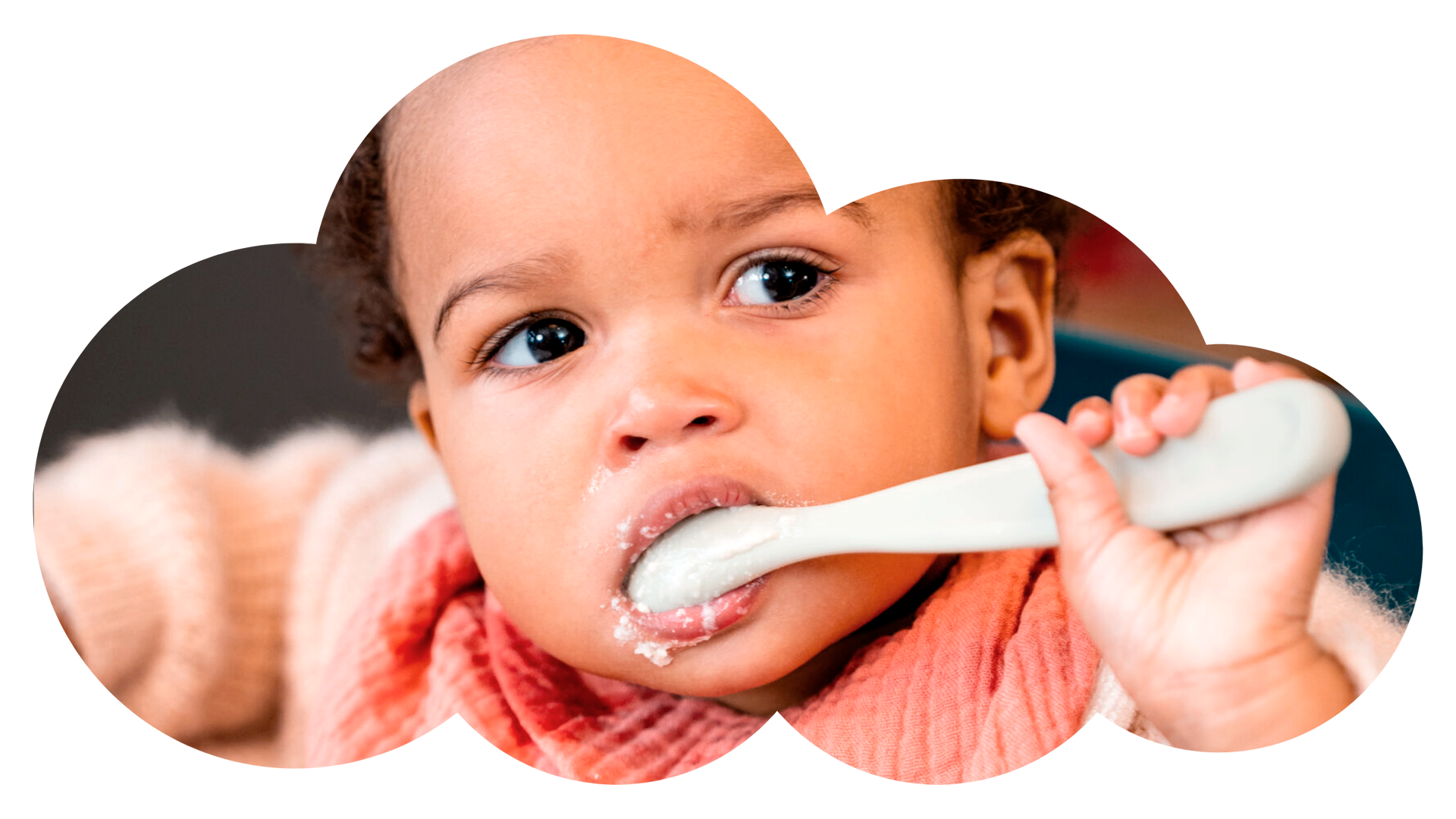
Baby’s complementary feeding
When and how to start baby food diversification from 6 months. Foods, textures, safety tips and guidance based on WHO recommendations.
In short:
- Food diversification should begin from 6 months of age, in line with World Health Organization (WHO) recommendations, and with the agreement of the child’s healthcare professional.
- Breast milk or infant formula remains essential throughout the entire diversification period.
- Introducing a wide variety of foods, followed by a gradual progression in textures, supports long-term food acceptance.
- Respecting a baby’s hunger and satiety cues is essential for calm and positive mealtimes.
Baby’s complementary feeding: supporting the discovery of foods, from 6 months
Food diversification is a key stage in an infant’s development. After several months of exclusively milk-based feeding, babies gradually begin to explore new foods, textures, and flavors. This transition reflects the natural evolution of their nutritional needs, physiological abilities, and motor and sensory development.
When should food diversification begin? Which foods should be introduced first? How can parents respect their baby’s rhythm while ensuring safety and nutritional balance?
In this article, we provide clear guidance based on international recommendations, to help families navigate this stage with confidence and peace of mind.
Complementary feeding: what does it really mean?
Complemetary feeding (or food diversification) refers to the gradual introduction of foods other than milk into a baby’s diet. It marks the transition from an exclusively milk-based diet to a more varied one, while keeping breast milk or infant formula as the nutritional foundation.
The first foods offered are usually vegetables and fruits, followed progressively by starchy foods and protein sources. Textures evolve gradually, from smooth purées to mashed foods and then to small, soft pieces, supporting the development of chewing skills.
This period represents a major learning phase: babies develop their sense of taste, refine their oral motor skills, and begin to build a new relationship with food.
Why is complementary feeding such an essential stage?
Meeting the baby’s evolving nutritional needs
From around 6 months of age, an infant’s nutritional requirements increase. Certain nutrients—such as iron, zinc, and some vitamins—can no longer be supplied in sufficient amounts by milk alone. Introducing complementary foods helps meet these growing needs while supporting overall growth and development.
Encouraging taste development and healthy eating habits
The first years of life are a critical window for shaping food preferences. Repeated exposure to a wide variety of foods and flavors—even when initially refused—supports better long-term acceptance of foods.
A relational and social experience
Food diversification is not only about nutrition. It also takes place within an emotional and social context: babies observe, imitate, and gradually share mealtimes with their family. These interactions help build a positive and confident relationship with food.
When should food diversification begin?
The World Health Organization (WHO) recommends exclusive milk feeding until 6 months of age, followed by the introduction of appropriate complementary foods, while continuing breastfeeding up to 2 years of age or beyond.[1]
Introducing complementary foods before 6 months has not been shown to provide nutritional benefits and may increase the risk of gastrointestinal infections. Conversely, delaying diversification beyond 6 months may increase the risk of nutritional deficiencies, particularly iron deficiency.
How can you tell if your baby is ready for complementary feeding?
Beyond age, several signs indicate that a baby may be ready:
- He can hold his head up steadily and sit with support,
- He shows interest in foods eaten by adults,
- He spontaneously brings objects to his mouth,
- The tongue-thrust reflex (pushing food out with the tongue) has diminished.
These signs reflect sufficient neuromotor maturity to handle textures other than milk.
The main stages of food diversification
From 6 to 8 months: first explorations
At this stage, milk remains the main source of nutrition. Solid foods are offered in small amounts, primarily for sensory discovery, with 2 to 3 meals per day.[1]
Textures should initially be smooth and homogeneous. Well-cooked and blended vegetables (such as zucchini, carrot, or pumpkin) are often introduced first, followed by cooked fruit purees (without added sugar). Quantities are modest and increase gradually according to the baby’s appetite.
Textures then slowly evolve toward thicker purees, mashed foods, and soft preparations. New food groups are introduced progressively:
- Starchy foods (rice, pasta, legumes, etc.)
- Animal proteins (meat, fish, egg, always fully cooked), in small quantities
Did you know?
Fats play an essential role in a baby’s diet, particularly as a source of essential fatty acids (such as omega-3 and omega-6), which are crucial for the development of the brain, nervous system, and vision. From the very beginning of food diversification, adding a small amount of raw fat (such as a suitable vegetable oil like rapeseed oil or a balanced oil blend) to purées and meals helps meet these specific nutritional needs. Contrary to common belief, fats should not be restricted in young children—they are vital for healthy growth and overall development.
From 8 to 23 months: discovering pieces and structuring meals
Around 8 months of age, it becomes important to start offering small, well-cooked, soft pieces of food. Gradually, as chewing skills develop, these pieces can become less soft.
Meal patterns also begin to take shape, with 3 to 4 meals per day for babies aged 9 to 23 months, plus one or two additional snacks if needed.[1]
Quantities and rhythms: following the child is key
There is no universal portion size suitable for all babies. Appetite varies depending on age, growth, and developmental phases. The goal is to offer balanced meals while respecting hunger and fullness cues.
Forcing a child to eat can disrupt their natural ability to self-regulate. In contrast, a calm and pressure-free environment supports a healthy relationship with food.
An important indicator to monitor remains the child’s growth curve, with regular follow-up by a healthcare professional.
How can food allergies be prevented?
Recent scientific evidence shows that delaying the introduction of allergenic foods does not reduce the risk of food allergies. It is now recommended to introduce them gradually, from the beginning of food diversification, in age-appropriate forms.
Foods such as kiwi or strawberries, as well as other common allergens like egg, peanut, and tree nuts (almonds, hazelnuts, etc.), can be offered in small quantities and in adapted forms (for example, as powders or purees), while carefully monitoring tolerance.
A successful complementary feeding with Mi&Ma!
Food diversification is a gradual process that supports a child’s overall development. Starting from 6 months, it helps meet evolving nutritional needs while fostering the learning of tastes and textures. By respecting your baby’s rhythm, offering a wide variety of foods, and keeping milk as the foundation of their diet, you help build the foundations for a calm and lasting relationship with food.
➡️ Discover our products designed to support food diversification!
Safety also relies on preventing choking risks: babies should always eat seated upright, under constant adult supervision, with foods that are well cooked and presented in textures appropriate to their chewing abilities.
Sources :
[1] : Infant and young child feeding, World Health Organization (WHO), December 2023
WHO Guideline for complementary feeding of infants and young children 6–23 months of age, OMS, 2023
Dewey, K. (2003). Guiding principles for complementary feeding of the breastfed child, Pan American Health Organization.
Discover other advice

Would you like to distribute the brand?
Do you share our vision of high-quality, accessible infant nutrition?
Would you like to offer families a comprehensive, consistent and reassuring range of products?
Let’s build a lasting partnership together, dedicated to helping babies grow up healthy, all over the world.
Contact us
Contact us